White paper: East Asian Battery giants fight for electrifying water transportation

Since 2019, China, Japan and South Korea have started to speed up the electrification of water transportation, in an on-going effort to improve their transport system and reduce dependency on fossil fuel vehicles. In 2020, despite the ongoing Covid-19 pandemic, the electrification of vessels has not shown any sign of slowing down in this region. Over the coming years, China, Japan and South Korea have all revealed ambitious plans for the electrification of water transportations.

Roskill’s White Paper reviews latest development of electrifying water transportation in China, Japan and South Korea and analyses the reasons of East Asian advances in electric vessels. The success of electric transportation is very dependent on the battery technology. The paper presents valuable insights on lithium-ion battery systems and chemistry type suitable for electric vessels.

In the long term, 60% of Chinese civil shipping vessels are forecast to be electrified. Roskill estimates this would create a potential demand for roughly 150GWh lithium-ion batteries. Correspondingly, the demand of cathode materials is expected to total 0.4Mt, requiring 62kt LCE of lithium products. Roskill’s policy analysis also identifies potential policy options that could reduce barriers and contribute to faster and safer adoption of electric ships.

Based on Roskill’s primary research and forecasting models, the paper outlines:

• Recent development of electrifying water transportation in East Asia
• Motivation: Why East Asian countries speed up electrification of vessel fleet
• Battery manufacturers fight for developing vessel lithium-ion battery system
• Battery technology and battery materials demand
• Implications for rare earths demand
• Future Development
Guoxuan to ramp up NCM battery business with VW

On July 16, Hefei Guoxuan Battery Materials, a subsidiary of Guoxuan High-Tech (also referred to as Gotion High-Tech), signed an agreement with the managerial committee of Hefei Lujiang Hi-tech Industrial Development Zone to build a high-nickel ternary cathode material plant. With an annual production capacity of 30.0kt, the cathode materials plant is scheduled to start test operations in early 2023.

Roskill’s view

In May 2020, German automaker Volkswagen AG confirmed an investment in Guoxuan, becoming Guoxuan’s biggest shareholder with a 26.47% stake. Almost immediately Guoxuan announced its plan to raise roughly RMB7.3Bn (US$1Bn) by issuing a non-public issuance of stocks. The majority of the fund is scheduled to build a high-nickel ternary cathode material plant capable of producing 30.0ktpy, and a lithium-ion battery plant with an annual production capacity of 16GWh.

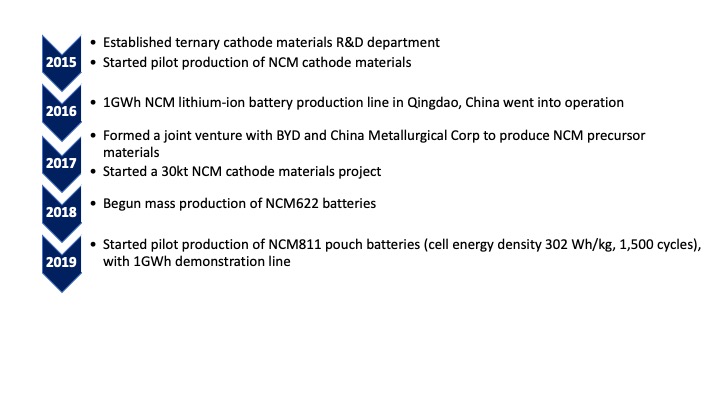
Guoxuan is the third largest lithium-ion battery manufacturer in China, relying primarily on LFP technology for its batteries. In 2019, Guoxuan was operating around 2GWhpy of NCM battery effective manufacturing capacity, far below its 10GWhpy of LFP battery capacity. Since 2015, however, Guoxuan has strategically build up capacity in the field of NCM batteries. The company noted that vertical integration of their supply chain has been a core strategy of Guoxuan, with a particular emphasis on self-supply of cathode materials. By 2020, Guxuan has covered multiple stages of the NCM lithium-ion battery supply chain, including NCM precursor materials, cathode materials and batteries. The 30ktpy cathode materials plant based in Hefei, together with the 16GWh battery project, represent the next steps for Guoxuan to build market share in the NCM cathode and battery industries.

Milestones of Guoxuan’s NCM battery development

Source: Roskill, public announcements

In H1 2020, Guoxuan’s net profit fell between 89-91% compared with a year earlier to RMB30.5-39.5M (US$4.4-5.6M). This is mainly caused by the Covid-19 pandemic and the resulting decline in downstream demand. While LFP has been gaining increasing attention in the EV market, Roskill expects nickel-based cathode will continue to be the go-to option for more automakers offering driving over 400-500km or performance vehicles as nickel-based cathodes have higher energy density (gravimetric and volumetric energy density).  Guoxuan’s investment in NCM cathode materials goes well with the power battery market trend, which could provide opportunities for lower cost, improved quality control and enhanced market competitiveness of their battery products. Despite a significant decline in revenue in H1 2020, Guoxuan’s 30kt NCM cathode materials project is regarded as a positive sign for the market. 

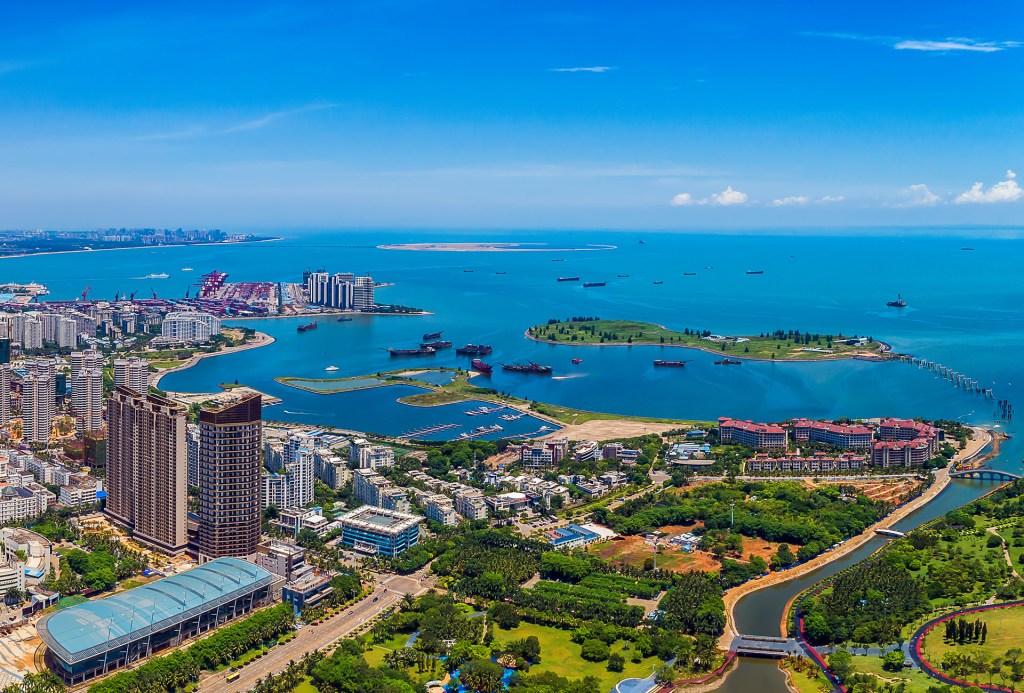
China’s Hainan officially confirm to ban oil-fuelled vehicles sales by 2030

In a press conference on June 8, China’s southern island province of Hainan confirmed a ban on ICE vehicles sales by 2030, making Hainan the first province in China to set a timetable by which the sales of ICE vehicles will be ended. The provincial government also vowed to shift the whole island to clean energy, in an effort to reduce emissions and improve air quality.

Roskill View

Hainan has been working strategically to phase out vehicles running on fossil fuels, with the governor of the province first indicating intentions to ban ICE vehicle sales in 2018. In 2019, the provincial government released its New Energy Vehicles Development Plan and proposed a progressive strategy, aiming to ensure that all private vehicles are running on clean energy by 2030. The government also scheduled to build an extensive network of vehicle-charging points across the island, with the total number of charging piles reaching 940,000 by 2030.

Rich in clean energy resources, including solar, wind and nuclear power, Hainan aims to build a reliable 80% clean electricity system by 2030. The electrification of the vehicle fleet is the starting point and charging infrastructure for EVs using clean energy is highlighted as a key target. Roskill’s sustainability analysis shows that a BEV has a much larger potential in reducing greenhouse gas emissions than an ICE vehicle during its ‘use’ stage, particularly EVs charged using electricity from clean energy sources.

Hainan’s plan to end ICE vehicles sales by 2030 is forecast to further boost battery and battery material demand, though Beijing remain reluctant to set a date for a nationwide ban on selling ICEs vehicles. Roskill believes that on a regional or national basis, the penetration rate of EVs follow uneven trajectories across different markets, driven by varying levels of local government support, commitments to the development of charging infrastructure, and the market position of manufacturers with leading positions in the EV markets. Known as a testing case for progressive policies, Hainan is leading the way among provincial-level governments, though how far similar policies propagate in other Chinese provinces over the coming decade will be critical to EV growth in the Chinese market. Central Chinese government will also need to think seriously about the effect of a nationwide transition to EVs, weighing up the impacts on other key industries and petroleum demand in China.